
Introduction
When selecting sanitary equipment for correctional facilities, detention centers, or other secure buildings, standard commercial wash basins are usually not the ideal choice.
These environments have very different requirements. The products need to withstand intensive daily use, frequent cleaning, and possible physical impact while maintaining a clean and functional appearance.
A stainless steel prison sink is developed specifically for these conditions. Compared with conventional ceramic or commercial wash basins, stainless steel security sinks provide stronger structural performance, easier maintenance, and greater flexibility for customized projects.
For facility managers, architects, and contractors, choosing the right sink is not only about appearance. It is about reducing maintenance problems and ensuring reliable operation over many years.
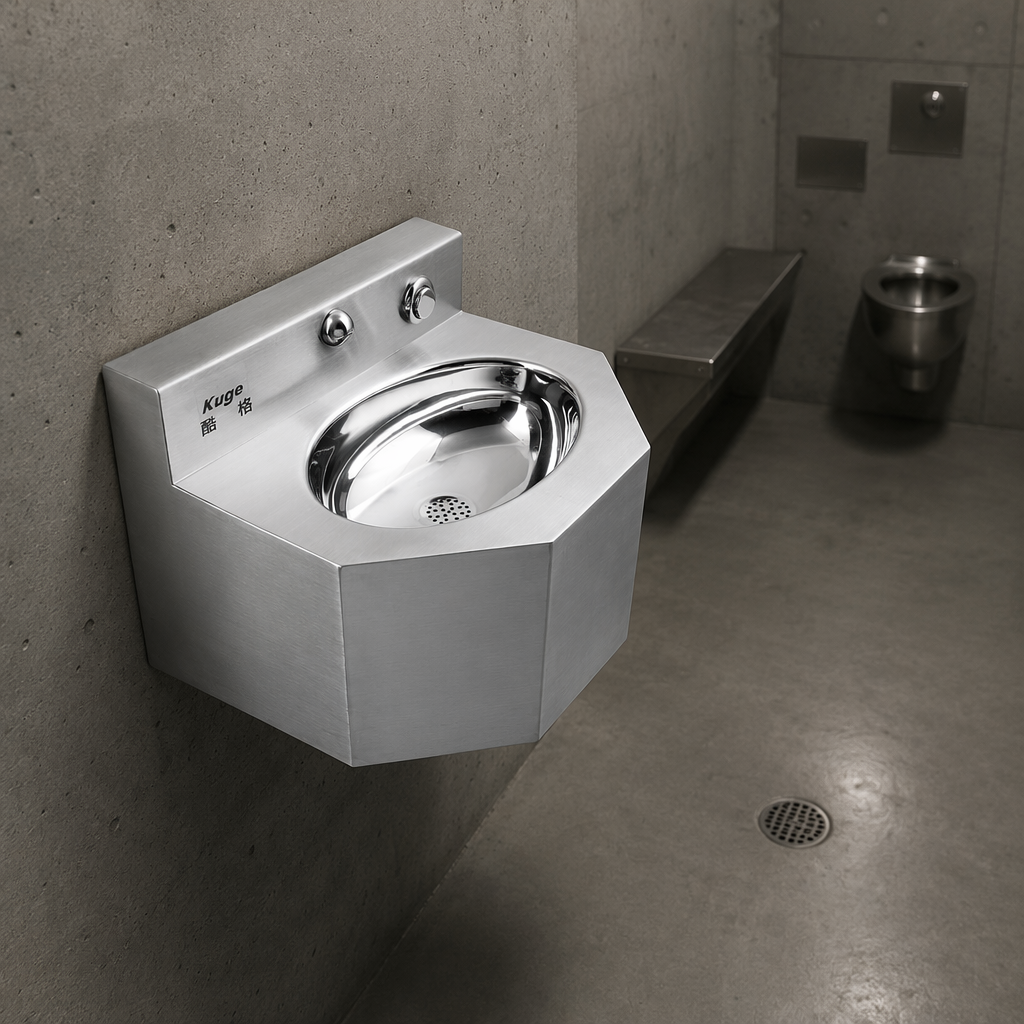
Why Are Stainless Steel Sinks Used in Correctional Facilities?
Traditional wash basins are designed mainly for hotels, offices, schools, and residential buildings.
However, correctional and institutional environments create additional challenges:
High frequency usage
Strict cleaning requirements
Increased risk of physical damage
Long operating hours
A damaged sanitary fixture in these environments can lead to additional maintenance work and replacement costs.
This is why many projects specify stainless steel security sinks instead of standard bathroom products.
The stainless steel structure provides a stronger solution while keeping the product simple and easy to maintain.
Structural Design of a Stainless Steel Prison Sink
A quality stainless steel prison sink is not simply a regular sink made from different material.
The design usually focuses on three areas:
1. Strong Stainless Steel Construction
Most security sinks are manufactured from stainless steel sheets, commonly 304 stainless steel.
Compared with ceramic products, stainless steel offers:
Higher impact resistance
Better resistance to cracking
Longer service life
For projects located in humid or corrosive environments, 316 stainless steel can also be selected for improved corrosion protection.
2. Secure and Simplified Structure
Institutional sanitary products usually avoid unnecessary components.
A practical security sink design often includes:
Smooth surfaces
Reduced exposed parts
Reinforced mounting structure
Easy-to-clean edges
The goal is to create a product that remains functional under demanding conditions while simplifying maintenance.
3. Professional Welding and Finishing
Manufacturing quality has a direct influence on product performance.
Important details include:
Uniform welding seams
Accurate forming
Proper surface treatment
Leakage inspection
For stainless steel sanitary products, these details determine whether the product can maintain stable performance after years of use.
Stainless Steel Prison Sink Applications
Although commonly associated with correctional facilities, stainless steel security sinks are also used in other institutional projects.
Correctional Facilities
These projects require sanitary products that combine durability and safety.
Stainless steel sinks are commonly selected because they can withstand continuous operation and reduce replacement frequency.
Psychiatric Healthcare Facilities
Mental healthcare environments often require products with additional safety considerations.
Depending on project requirements, sinks can be designed with features such as:
Smooth corners
Secure installation
Reduced exposed components
Military and Government Facilities
Institutional buildings often prioritize products with:
Long lifespan
Low maintenance requirements
Reliable performance
Choosing the Right Stainless Steel Prison Sink Manufacturer
For international projects, product quality depends not only on the design but also on the manufacturer's production capability.
Before selecting a supplier, buyers should consider:
Material Specification
Confirm:
Stainless steel grade
Material thickness
Surface finish
Custom Manufacturing Capability
Many institutional projects require customized solutions, such as:
Different dimensions
Special installation methods
Integrated faucet options
Project-specific designs
A manufacturer with OEM experience can better support these requirements.
Production Quality Control
Important inspection processes include:
Raw material checking
Welding inspection
Surface inspection
Water testing
These steps help ensure consistent quality for large-volume projects.
Frequently Asked Questions
What is a stainless steel prison sink?
A stainless steel prison sink is a heavy-duty sanitary fixture designed for correctional facilities and other secure institutional environments.
Why use stainless steel instead of ceramic?
Stainless steel provides better impact resistance and reduces the risk of cracking or replacement caused by damage.
Can stainless steel prison sinks be customized?
Yes. Manufacturers can customize dimensions, mounting structures, finishes, and configurations according to project requirements.
Which stainless steel grade is suitable?
304 stainless steel is commonly used for indoor applications. 316 stainless steel is recommended for areas exposed to higher corrosion risks.
Conclusion
Selecting sanitary products for correctional and institutional projects requires a different approach from normal commercial bathrooms.
A stainless steel prison sink provides a practical solution by combining strong construction, easy maintenance, corrosion resistance, and customization flexibility.
For architects, contractors, and facility operators, working with an experienced stainless steel sanitary manufacturer helps ensure the final product meets both safety expectations and long-term operational needs.
