
Introduction
When selecting sanitary equipment for public and commercial buildings, durability, hygiene, safety, and long-term maintenance costs are among the most important considerations. While ceramic toilets remain common in residential bathrooms, they are often unable to withstand the demands of high-traffic environments. This is where the stainless steel toilet has become the preferred solution.
Today, stainless steel toilets are widely installed in airports, railway stations, hospitals, correctional facilities, schools, factories, military bases, shopping malls, and other public infrastructure projects. Their exceptional strength, vandal resistance, corrosion resistance, and ease of maintenance make them a reliable investment for architects, contractors, facility managers, and government procurement departments.
In this article, we'll explore why stainless steel toilets continue to gain popularity worldwide, compare them with traditional ceramic toilets, discuss their most common applications, and explain how they can reduce maintenance costs over the lifetime of a building.
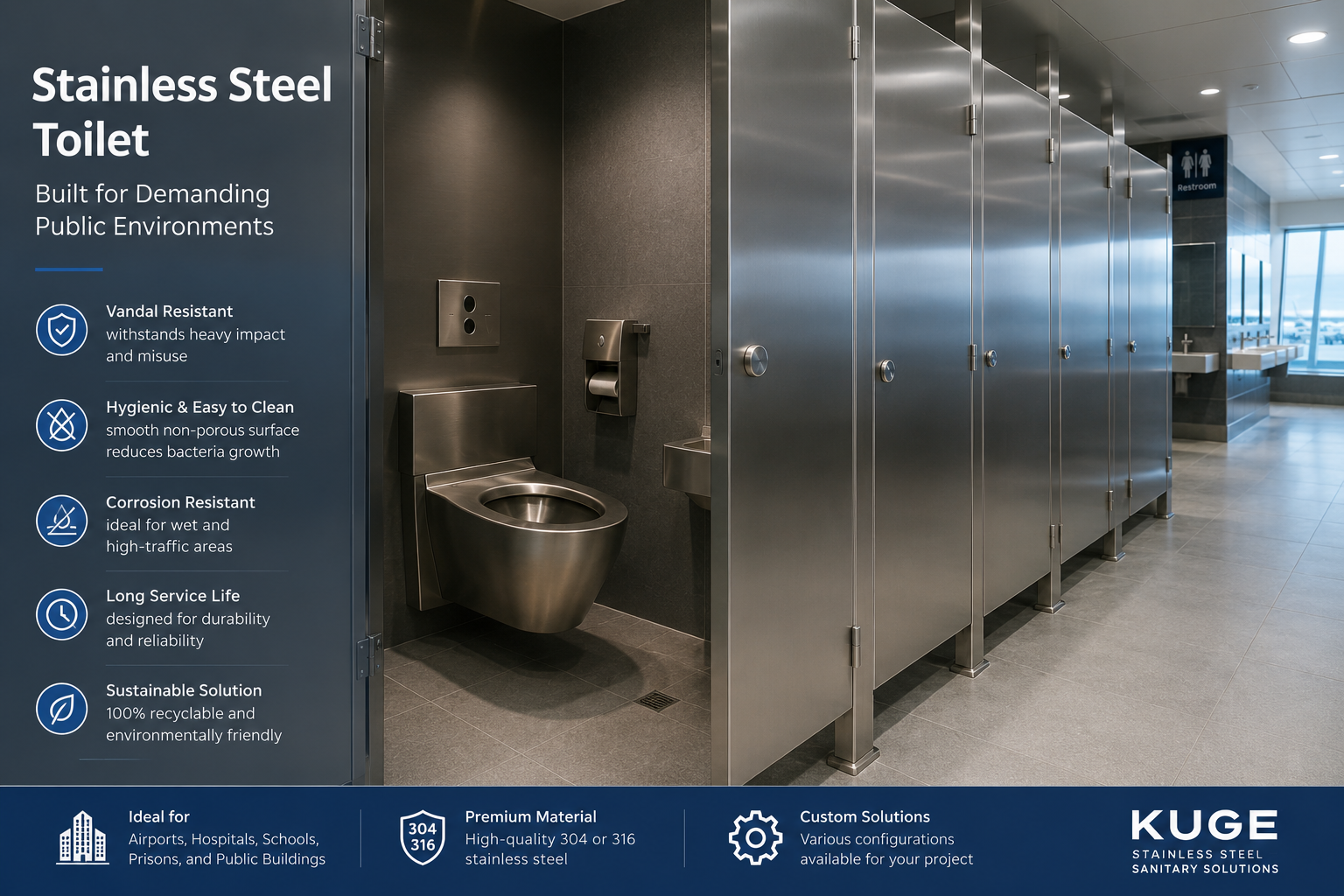
What Is a Stainless Steel Toilet?
A stainless steel toilet is a sanitary fixture manufactured primarily from high-quality stainless steel, typically Grade 304 or Grade 316. Unlike traditional ceramic toilets, these units are specifically engineered for environments where heavy daily usage, security, hygiene, and durability are essential.
Depending on project requirements, stainless steel toilets are available in multiple configurations, including:
Floor-mounted stainless steel toilets
Wall-mounted stainless steel toilets
Concealed cistern toilets
Correctional facility toilets
Combined toilet and wash basin units
Accessible toilets for disabled users
Custom OEM stainless steel toilet solutions
Modern manufacturing technologies such as CNC laser cutting, robotic welding, precision polishing, and leak testing ensure consistent quality and long service life.
Why Public Facilities Need More Durable Toilet Solutions
Public washrooms operate under completely different conditions than residential bathrooms.
A restroom inside an airport may serve several thousand visitors every day. Hospitals require strict hygiene standards to reduce contamination risks. Schools and stadiums must accommodate continuous usage during peak hours, while correctional facilities require fixtures that resist intentional damage.
Traditional ceramic toilets perform well in homes but often present challenges in these demanding environments.
Common problems include:
Cracked bowls caused by accidental impacts
Broken cisterns requiring replacement
Surface chipping after years of use
Higher maintenance frequency
Greater replacement costs
Increased downtime for repairs
A commercial stainless steel toilet addresses these challenges by providing superior mechanical strength and long-term reliability.
For facility managers, reducing maintenance interruptions directly translates into lower operational costs and improved user satisfaction.
Top Advantages of Stainless Steel Toilets
1. Exceptional Durability
Perhaps the greatest advantage of a stainless steel toilet is its outstanding durability.
Unlike ceramic materials, stainless steel does not crack when subjected to heavy impacts. This makes it particularly suitable for public environments where accidental damage or misuse is more likely.
Typical benefits include:
High impact resistance
Excellent structural strength
Long service life
Minimal repair requirements
Reliable performance under intensive use
Many stainless steel toilets continue operating efficiently for more than 25 years with routine maintenance.
2. Superior Hygiene Performance
Hygiene has become a major priority for building designers worldwide.
Stainless steel features a smooth, non-porous surface that discourages bacterial growth and simplifies cleaning procedures.
Compared with porous materials, stainless steel offers several hygienic advantages:
Easier daily cleaning
Faster disinfection
Resistance to staining
Excellent chemical compatibility
Reduced bacterial accumulation
For this reason, hospital stainless steel toilets are increasingly specified in healthcare facilities where infection control is critical.
3. Outstanding Corrosion Resistance
Public washrooms are constantly exposed to moisture, cleaning chemicals, humidity, and temperature changes.
High-quality 304 stainless steel toilets provide excellent resistance against corrosion under normal commercial conditions.
For coastal regions, marine environments, or chemical plants, 316 stainless steel toilets offer even greater resistance to chlorides and aggressive chemicals.
This corrosion resistance helps preserve appearance while minimizing maintenance costs.
4. Excellent Vandal Resistance
One of the primary reasons correctional facilities select stainless steel toilets is vandal resistance.
Unlike ceramic fixtures, stainless steel units are extremely difficult to damage intentionally.
Many correctional-grade models feature:
Fully welded construction
Tamper-resistant fasteners
Concealed plumbing connections
Anti-ligature designs
Reinforced mounting systems
These features improve both safety and long-term operational reliability.
5. Long Service Life
Although stainless steel toilets generally involve a higher initial investment, their lifecycle value is significantly greater.
Instead of replacing damaged ceramic fixtures every several years, facility owners can expect decades of dependable performance.
Factors contributing to longer lifespan include:
Durable material
Professional welding
Corrosion resistance
Reduced maintenance
Structural integrity
Over a 20–30 year building lifecycle, this often results in substantial cost savings.
6. Sustainable and Environmentally Friendly
Sustainability is becoming an important factor in modern construction.
Stainless steel is one of the world's most recyclable materials.
Many manufacturers use recycled stainless steel during production, reducing environmental impact without sacrificing performance.
Additionally, the extended lifespan of stainless steel toilets reduces construction waste associated with frequent replacements.
Common Applications of Stainless Steel Toilets
Different industries have different sanitation requirements.
Because of their versatility, stainless steel toilets can be customized for numerous applications.
Hospitals
Healthcare facilities prioritize hygiene, easy cleaning, and corrosion resistance.
Hospital-grade stainless steel toilets support infection control protocols while maintaining long-term durability.
Airports
Airports experience continuous passenger traffic throughout the day.
A durable commercial stainless steel toilet helps reduce maintenance interruptions and ensures restroom availability.
Schools and Universities
Educational institutions require sanitary equipment capable of handling heavy daily use while minimizing repair costs.
Railway Stations
Transportation hubs demand vandal-resistant, easy-to-maintain sanitary solutions capable of serving thousands of passengers.
Correctional Facilities
Security remains the highest priority.
Specialized prison stainless steel toilets feature anti-vandal and anti-ligature designs that improve inmate safety while reducing maintenance.
