
Introduction
Selecting a stainless steel toilet for a commercial or public project is not as simple as choosing a standard bathroom fixture. Different environments require different levels of durability, hygiene performance, installation structures, and security features.
For example, a hospital requires strict hygiene compliance, while a prison demands anti-vandal and anti-ligature designs. Airports and railway stations prioritize long-term durability under extremely high traffic, while industrial facilities may require corrosion resistance in harsh environments.
Because of these differences, choosing the wrong type of toilet can result in increased maintenance costs, operational disruptions, and shortened product lifespan.
This guide explains everything you need to know before purchasing a stainless steel toilet, helping architects, contractors, and project managers make informed decisions.
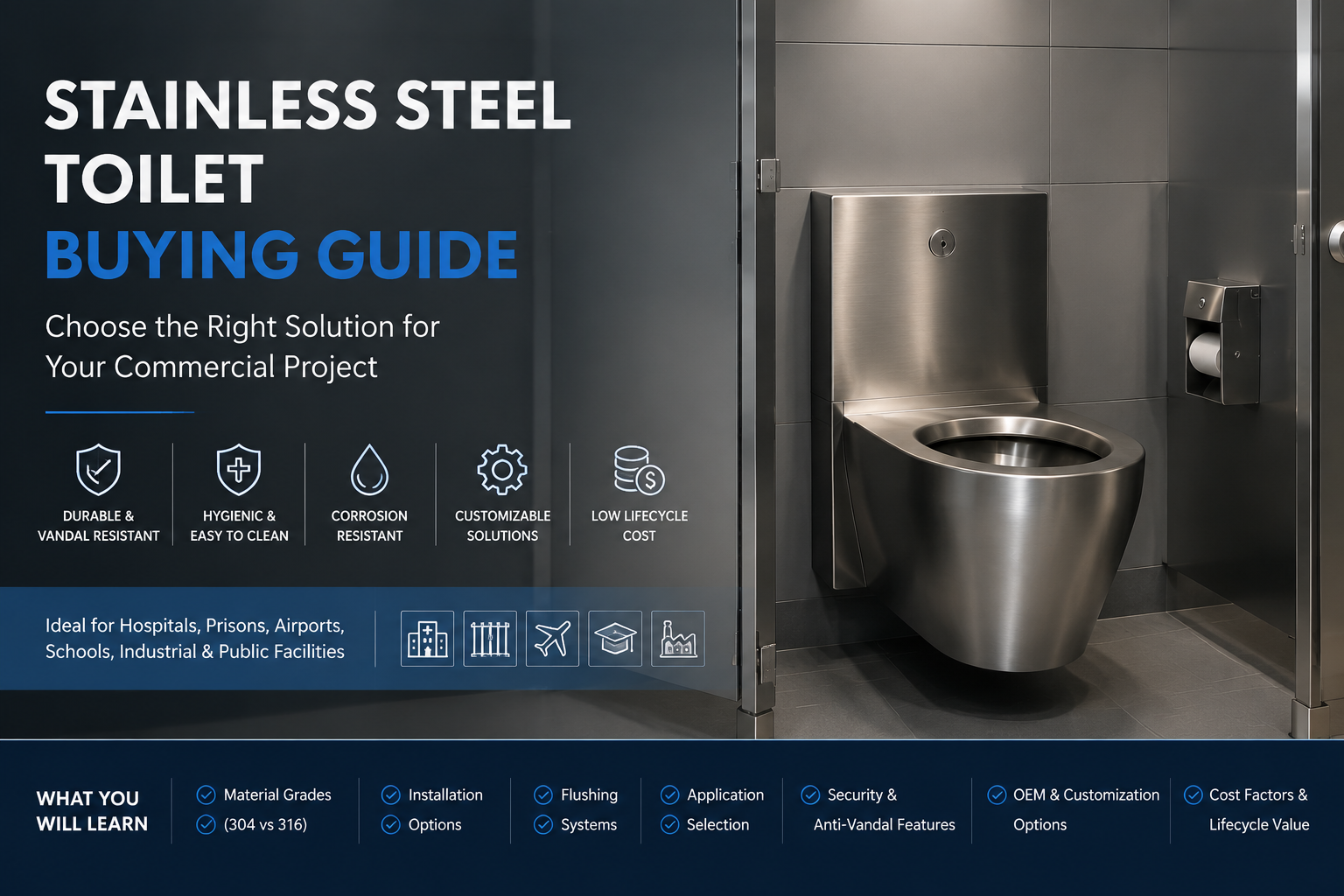
1. Understanding Stainless Steel Toilet Types
Before selecting a product, it is important to understand the different types of stainless steel toilets available on the market.
Common configurations include:
Floor-mounted stainless steel toilet
Wall-mounted stainless steel toilet
Integrated toilet and sink unit
Prison-grade stainless steel toilet
Accessible (ADA-compliant) toilet
One-piece welded toilet systems
Each type is designed for specific environments and performance requirements.
2. Material Selection: 304 vs 316 Stainless Steel
One of the most important decisions is selecting the correct stainless steel grade.
304 Stainless Steel
304 is the most commonly used material for commercial stainless steel toilets.
It offers:
Strong corrosion resistance
Good durability
Cost efficiency
Suitable for indoor public facilities
Typical applications:
Schools
Shopping malls
Office buildings
Indoor airports
316 Stainless Steel
316 is a higher-grade material with enhanced resistance to chemicals and salt corrosion.
It is recommended for:
Coastal areas
Marine environments
Chemical plants
High-corrosion industrial zones
Although more expensive, 316 significantly extends product lifespan in harsh environments.
3. Installation Types Explained
Different installation methods affect both maintenance and long-term usability.
Wall-mounted stainless steel toilet
Easier floor cleaning
Modern appearance
Concealed plumbing system
Floor-mounted stainless steel toilet
Stronger structural support
Easier installation
Common in high-traffic facilities
Integrated systems
Combine toilet and washbasin
Ideal for space-saving public restrooms
Often used in transportation hubs
4. Flushing System Options
A stainless steel toilet can be combined with different flushing technologies:
Manual flush valve system
Sensor-based automatic flush
Concealed cistern system
Pressure-assisted flushing
Sensor-based systems are increasingly used in modern commercial buildings due to hygiene advantages and water-saving performance.
5. Application-Based Selection Guide
Different industries require different configurations:
Hospitals
High hygiene requirements
Easy cleaning
Anti-bacterial surface treatment
Prisons
Anti-vandal construction
Anti-ligature design
Fully welded structure
Airports & Railways
High traffic durability
Low maintenance
Fast cleaning cycle
Schools
Cost efficiency
Impact resistance
Easy replacement systems
6. Security & Anti-Vandal Requirements
In high-risk environments, standard toilets are not sufficient.
A prison stainless steel toilet or anti-vandal model typically includes:
Hidden screws and fasteners
Reinforced stainless steel body
Tamper-proof design
One-piece welded structure
Rounded safety edges
These features ensure safety and reduce maintenance risks.
7. OEM & Customization Options
For large-scale projects, customization is often required.
OEM stainless steel toilet solutions may include:
Custom dimensions
Branding options
Special flushing systems
ADA compliance modifications
Integrated sink combinations
Surface finish customization
Manufacturers like KUGE often support full OEM/ODM production for international projects.
8. Cost Factors You Should Consider
When evaluating a stainless steel toilet, do not only consider purchase price.
Key cost factors include:
Installation cost
Maintenance cost
Replacement frequency
Downtime cost
Cleaning labor cost
Lifecycle cost (10–30 years)
In most public projects, stainless steel toilets deliver lower total lifecycle cost compared to ceramic alternatives.
9. Frequently Asked Questions (FAQ)
1. How long does a stainless steel toilet last?
Typically 20–30 years depending on environment and usage.
2. Is stainless steel toilet hygienic?
Yes. It has a non-porous surface that is easy to clean and disinfect.
3. Can stainless steel toilets be used in hospitals?
Yes, they are widely used in hospital-grade sanitation systems.
4. What is the difference between 304 and 316 stainless steel?
316 offers higher corrosion resistance, especially in marine environments.
5. Are stainless steel toilets vandal resistant?
Yes, especially in correctional and public facility models.
Conclusion
Choosing the right stainless steel toilet is a strategic decision that affects long-term operational cost, hygiene performance, and facility reliability.
By selecting the correct material grade, installation type, and application-specific design, project owners can significantly improve performance while reducing lifecycle costs.
For large-scale commercial and public infrastructure projects, stainless steel toilets remain one of the most reliable sanitary solutions available today.
