
Introduction
Selecting the right toilet is no longer just about appearance or initial purchase price. For commercial buildings, healthcare facilities, transportation hubs, correctional institutions, and public infrastructure, restroom fixtures are expected to perform reliably for decades while minimizing maintenance and operating costs.
Two of the most common choices are stainless steel toilets and ceramic toilets. Although both serve the same purpose, they are designed for very different environments and deliver significantly different long-term performance.
Ceramic toilets remain the standard option for residential bathrooms because of their familiar appearance and affordability. However, when projects involve heavy daily traffic, strict hygiene standards, or a higher risk of vandalism, stainless steel toilets have become the preferred choice for architects, facility managers, and government procurement teams.
This guide provides an objective comparison between these two materials, helping you determine which option offers the best value for your specific application.
Understanding the Two Materials
Although they perform the same basic function, ceramic and stainless steel toilets are manufactured using completely different materials and production processes.
A ceramic toilet is typically made from vitreous china, fired at extremely high temperatures and coated with a glazed surface. It offers a smooth finish and is widely used in homes, hotels, and apartments where daily usage is relatively moderate.
A stainless steel toilet, by contrast, is fabricated from corrosion-resistant stainless steel sheets—most commonly Grade 304 or Grade 316. Through precision laser cutting, forming, robotic welding, and surface finishing, the final product is engineered to withstand intensive use, physical impact, and harsh environments.
Because of these fundamental differences, each material excels in different situations.
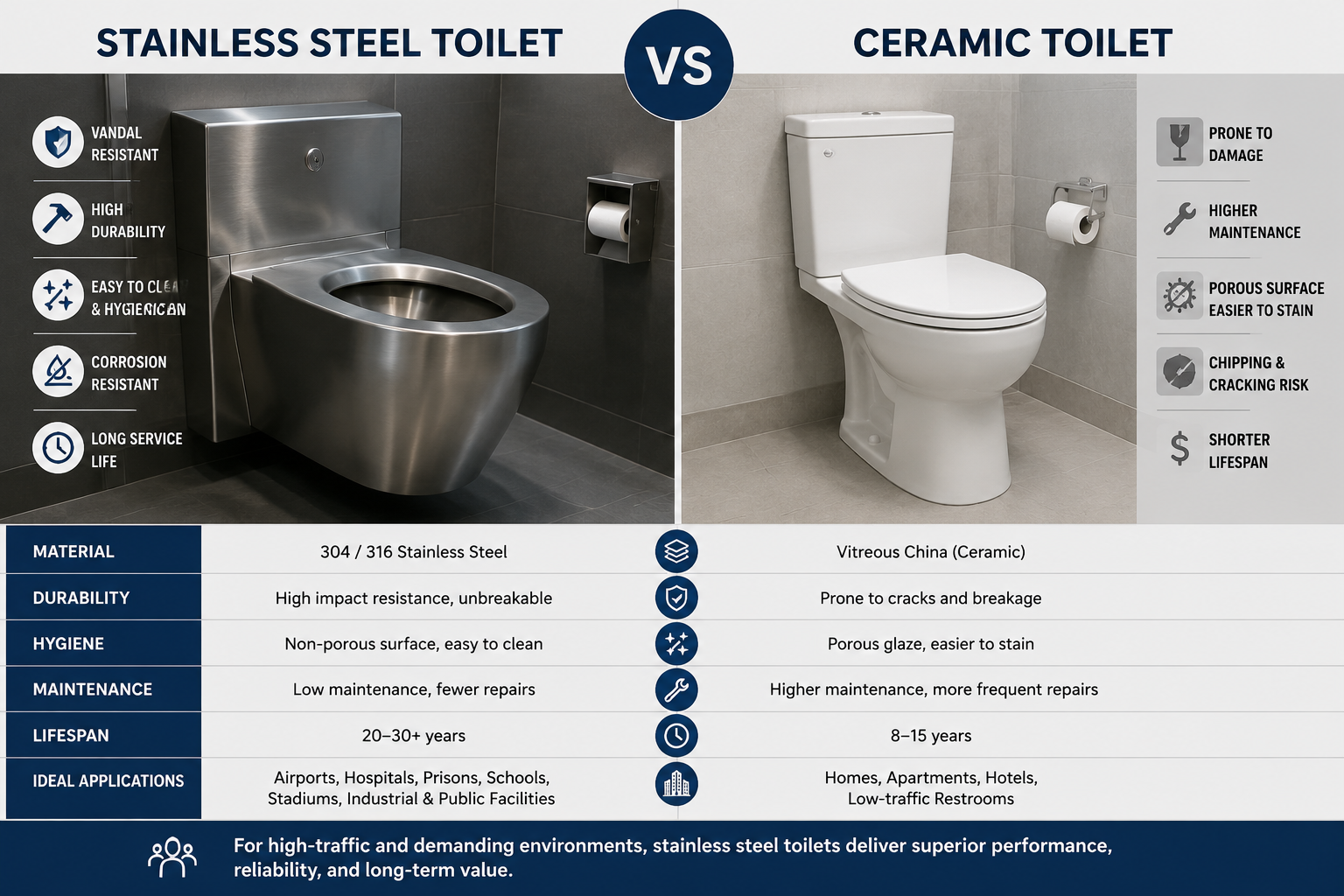
Structural Strength Comparison
One of the most noticeable differences between ceramic and stainless steel is structural integrity.
Ceramic is inherently rigid but brittle. While it performs well under normal household conditions, it can crack or shatter if subjected to heavy impact. In commercial buildings, accidental damage caused by luggage carts, maintenance equipment, or vandalism can lead to costly repairs and restroom downtime.
A stainless steel toilet is manufactured as a welded metal structure that is highly resistant to impact. Even in demanding public environments, it maintains its shape and functionality with minimal risk of damage.
This strength makes stainless steel particularly suitable for:
Transportation terminals
Public restrooms
Stadiums
Industrial facilities
Educational institutions
Correctional environments
Performance Under Heavy Daily Use
Traffic volume plays an important role in fixture selection.
A residential toilet may be used only a few times per day, while a toilet in an airport or shopping mall can serve hundreds—or even thousands—of users within the same period.
High-frequency use places continuous stress on every component, including the bowl, flushing system, mounting hardware, and surrounding infrastructure.
Because stainless steel toilets are designed specifically for these demanding conditions, they typically provide:
Greater structural stability
Reduced maintenance interruptions
Lower risk of accidental damage
Longer replacement cycles
For projects where uninterrupted restroom availability is essential, this level of reliability becomes a significant operational advantage.
Hygiene and Cleaning Requirements
Cleanliness is a priority in every restroom, but the level of hygiene required varies by industry.
Healthcare facilities, laboratories, food processing plants, and pharmaceutical manufacturers often follow strict cleaning protocols that involve frequent disinfection with chemical cleaning agents.
The smooth, non-porous surface of stainless steel allows contaminants to be removed quickly while resisting many cleaning chemicals commonly used in commercial facilities.
Ceramic toilets also provide a smooth glazed surface, but over time, repeated impacts, scratches, or chipped glazing may create areas where dirt and stains are more difficult to remove.
For facilities with rigorous sanitation requirements, stainless steel is often selected because it supports faster cleaning procedures and consistent hygiene performance.
Maintenance and Repair Costs
The purchase price of a restroom fixture represents only a small portion of its total lifecycle cost.
Building owners should also consider:
Repair frequency
Spare parts
Labour costs
Service interruptions
Replacement expenses
Long-term maintenance planning
Although ceramic toilets usually have a lower upfront cost, unexpected breakage can significantly increase maintenance budgets over time.
By contrast, stainless steel toilets are designed to minimise these risks through their robust construction and resistance to physical damage.
Many facility managers report that the reduced need for repairs offsets the higher initial investment over the product's service life.
Water Efficiency and Sustainability
Modern commercial restroom design increasingly focuses on environmental performance.
Both ceramic and stainless steel toilets can be paired with water-saving flush valves, dual-flush systems, or sensor-operated controls.
However, stainless steel offers an additional sustainability advantage because the material itself is highly recyclable.
Many stainless steel sanitary products are manufactured using recycled raw materials and can be recycled again at the end of their service life.
Combined with a long operational lifespan, this contributes to a lower environmental footprint over the lifetime of the building.
Appearance and Design Flexibility
A common misconception is that stainless steel toilets are intended only for prisons or industrial facilities.
In reality, advances in manufacturing have enabled a wide range of finishes and configurations suitable for modern architectural projects.
Options include:
Satin finish
Brushed finish
Matte finish
Wall-mounted designs
Floor-mounted models
Concealed plumbing systems
Integrated wash basin combinations
These design options allow architects to balance aesthetics with durability, particularly in contemporary public buildings.
Which Industries Benefit Most from Stainless Steel Toilets?
While ceramic toilets remain suitable for residential projects, stainless steel toilets provide greater value in demanding commercial environments.
Typical applications include:
Healthcare Facilities
Reliable hygiene and easy cleaning support infection control measures.
Transportation Infrastructure
Airports, railway stations, bus terminals, and ports benefit from high durability and low maintenance.
Educational Institutions
Schools and universities require restroom fixtures capable of handling continuous daily use.
Industrial Facilities
Manufacturing plants often require corrosion-resistant sanitary equipment suitable for harsh environments.
Correctional Facilities
Security-focused designs, including anti-ligature and vandal-resistant models, help improve safety while reducing maintenance.
