
Introduction
In modern public infrastructure design, restroom systems are no longer treated as simple utility installations. Instead, they are considered a critical part of building efficiency, hygiene management, and user experience.
Among all sanitary fixtures, the stainless steel urinal has become an increasingly important solution for high-traffic environments such as airports, railway stations, schools, stadiums, factories, and correctional facilities.
Unlike traditional ceramic urinals, stainless steel systems are engineered for environments where durability, hygiene control, and long-term maintenance efficiency are essential.
This article explains how stainless steel urinals are used in public projects, why they are replacing ceramic alternatives in many large-scale developments, and what key factors should be considered during procurement and installation.
1. What Is a Stainless Steel Urinal System?
A stainless steel urinal is a sanitary fixture designed for male public restrooms, manufactured from corrosion-resistant stainless steel materials, typically Grade 304 or Grade 316.
Unlike ceramic urinals that are produced through casting and glazing, stainless steel urinals are fabricated using industrial processes such as:
Precision laser cutting
Robotic welding
Surface brushing or satin finishing
Anti-corrosion treatment
Structural reinforcement design
Depending on project requirements, stainless steel urinals can be configured as:
Wall-mounted urinal systems
Multi-user trough urinal systems
Sensor-flush urinal systems
Anti-vandal public restroom units
Integrated drainage systems
These variations allow them to be used in both standard commercial buildings and high-security environments.
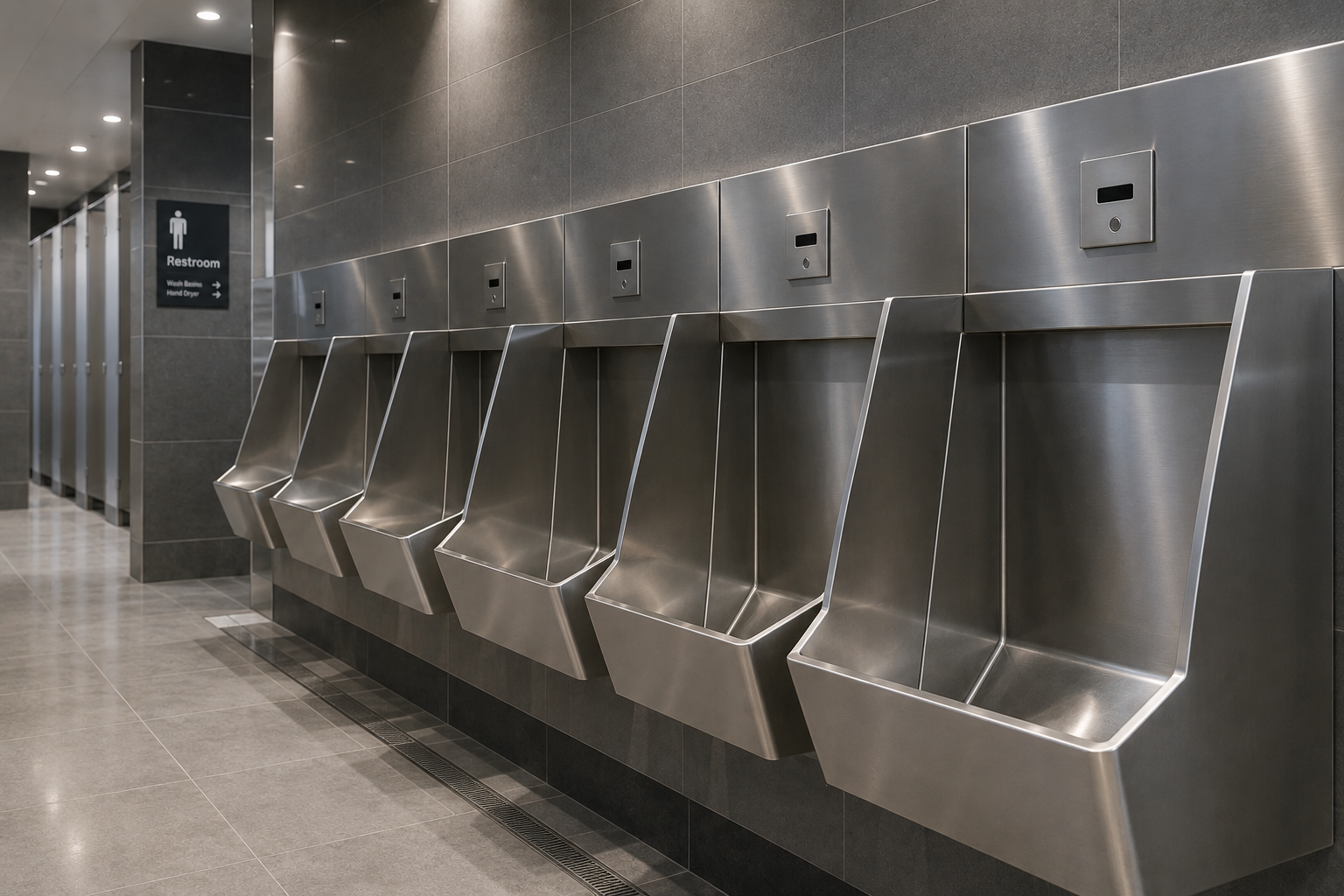
2. Why Public Restrooms Are Switching to Stainless Steel
The shift from ceramic to stainless steel urinals is driven primarily by operational demands rather than aesthetics.
In high-traffic facilities, restroom equipment must withstand:
Continuous daily usage
High cleaning frequency
Impact and misuse risks
Long operational cycles
Strict hygiene requirements
Ceramic urinals often face issues such as cracking, chipping, or surface damage over time, especially in environments where usage volume is extremely high.
A stainless steel urinal system provides a more stable long-term solution because it is structurally reinforced and resistant to physical impact.
For facility managers, the key motivation is not just durability, but also reducing downtime caused by maintenance or replacement.
3. Structural Design and Engineering Advantages
One of the most important advantages of stainless steel urinals is their engineered structure.
Unlike ceramic products that rely on material thickness for strength, stainless steel systems use metal fabrication techniques to achieve structural integrity.
Key engineering advantages include:
High impact resistance
Welded seamless construction
Reinforced mounting structure
Resistance to deformation
Anti-tamper design options
This makes stainless steel urinals suitable for environments where vandalism or heavy usage is a concern.
Typical installation environments include transportation hubs, public schools, and correctional facilities where durability is a critical requirement.
4. Hygiene Performance in High-Traffic Environments
Hygiene is one of the most important considerations in public restroom design.
A stainless steel urinal provides a non-porous surface that reduces the ability of bacteria, stains, and odor-causing residues to accumulate.
Compared with ceramic surfaces, stainless steel offers:
Faster cleaning cycles
Compatibility with strong disinfectants
Reduced bacterial retention
Improved odor control efficiency
Lower long-term contamination risk
In facilities such as hospitals or food processing environments, hygiene performance becomes a key reason for selecting stainless steel systems.
5. Installation Types and System Configurations
Stainless steel urinals are not limited to a single design format.
Depending on project scale and architectural requirements, several configurations are available:
Wall-Mounted Systems
Space-saving design
Easy floor cleaning
Common in commercial buildings
Multi-User Trough Systems
High-capacity usage
Ideal for stadiums and transport hubs
Efficient water usage per user
Sensor-Activated Systems
Touchless operation
Improved hygiene
Reduced water consumption
Anti-Vandal Systems
Reinforced structure
Concealed fasteners
Designed for correctional facilities
6. Application Scenarios Across Industries
A stainless steel urinal system is widely used across multiple sectors due to its adaptability.
Airports and Railway Stations
Designed for continuous passenger flow and minimal maintenance downtime.
Schools and Universities
Require durability and resistance to heavy daily use.
Correctional Facilities
Require anti-vandal, tamper-resistant construction.
Industrial Facilities
Suitable for harsh environments and chemical exposure areas.
Stadiums and Event Venues
Require high-capacity drainage systems for peak usage periods.
7. Maintenance and Lifecycle Cost Benefits
Although stainless steel urinals may involve higher initial investment, their lifecycle cost is significantly lower in many commercial applications.
Key cost-saving factors include:
Reduced replacement frequency
Lower repair requirements
Faster cleaning operations
Reduced downtime
Longer operational lifespan
Over a 15–25 year lifecycle, stainless steel systems often outperform ceramic alternatives in total cost efficiency.
Conclusion
A stainless steel urinal system is not just a sanitary fixture—it is a long-term infrastructure solution designed for high-performance public environments.
With superior durability, improved hygiene efficiency, and significantly reduced lifecycle maintenance costs, stainless steel urinals are becoming the preferred choice for modern public restroom design worldwide.
