
Introduction
Choosing the right urinal for a commercial restroom is a long-term investment rather than a simple purchasing decision. The material you select will influence maintenance costs, cleaning efficiency, durability, and even the overall user experience throughout the life of the building.
For decades, ceramic urinals have been the standard choice for offices, hotels, and residential buildings because of their clean appearance and relatively low initial cost. However, as public facilities continue to experience heavier traffic and higher maintenance demands, stainless steel urinals have become the preferred option for many architects, contractors, and facility managers.
Airports, railway stations, stadiums, schools, hospitals, industrial plants, and correctional facilities increasingly specify stainless steel fixtures because they are designed to withstand demanding environments while reducing long-term operating costs.
This article compares stainless steel urinals and ceramic urinals from multiple perspectives, helping project owners determine which solution best fits their building requirements.
1. Material Overview
Although stainless steel and ceramic urinals perform the same function, they are manufactured using completely different materials and production technologies.
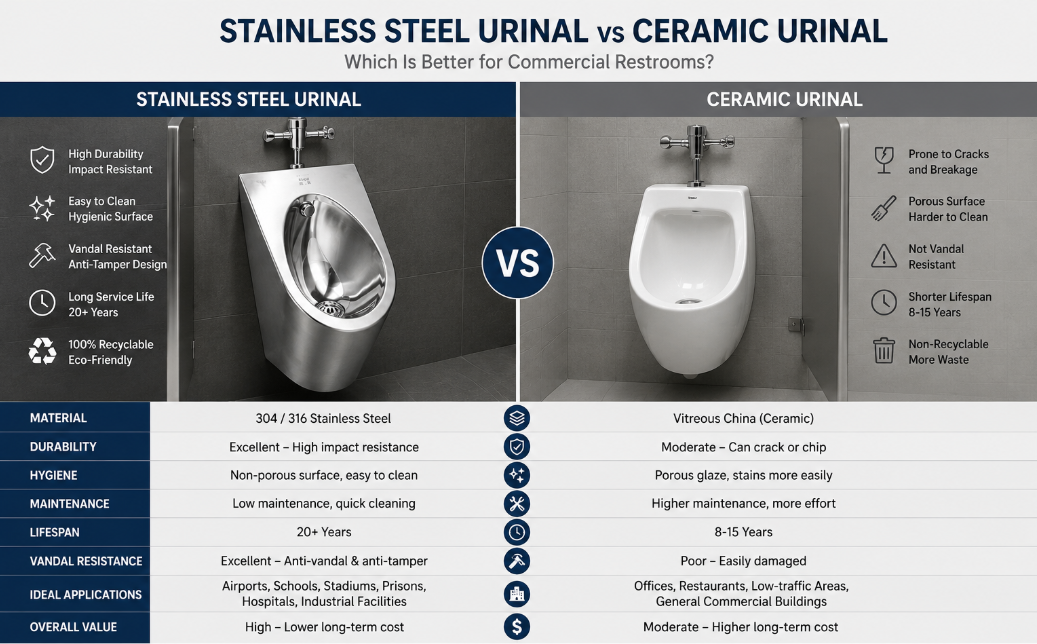
Ceramic urinals are produced from vitreous china, fired at high temperatures, and finished with a glazed surface. They are suitable for light- to medium-duty applications where aesthetics are a primary concern.
A stainless steel urinal, by contrast, is fabricated from Grade 304 or Grade 316 stainless steel using precision laser cutting, bending, robotic welding, and surface finishing processes. This manufacturing method creates a product capable of withstanding heavy daily use, physical impact, and frequent cleaning with industrial disinfectants.
The choice between these two materials depends largely on the environment in which the restroom will operate.
2. Durability Comparison
One of the biggest differences between ceramic and stainless steel lies in structural strength.
Ceramic provides excellent rigidity and a smooth finish, but it is inherently brittle. In busy public restrooms, accidental impacts from luggage carts, maintenance equipment, or intentional vandalism can lead to cracks or chips that require complete replacement.
A commercial stainless steel urinal offers significantly greater resistance to physical damage. Its welded metal construction is designed to absorb impact without compromising structural integrity, making it a dependable choice for facilities that experience constant daily use.
For transportation hubs, schools, industrial sites, and public venues, this added durability translates into fewer interruptions and lower replacement costs over time.
3. Hygiene and Cleaning
Maintaining a clean restroom is essential for user satisfaction and public health.
Both ceramic and stainless steel feature smooth surfaces that are easy to clean. However, stainless steel provides several advantages in demanding commercial environments.
A stainless steel urinal is resistant to many industrial cleaning chemicals and does not rely on a glazed coating that can become damaged over years of heavy use.
Its non-porous surface helps reduce residue buildup, supports faster cleaning routines, and contributes to better odor control in high-traffic restrooms.
These characteristics make stainless steel particularly suitable for healthcare facilities, transportation terminals, and food processing plants where sanitation standards are especially high.
4. Water Efficiency
Water conservation has become a key objective in modern commercial building design.
Both ceramic and stainless steel urinals can be paired with efficient flushing technologies such as:
Sensor-operated flushing systems
Manual flush valves
Low-flow flushing devices
Water-saving control systems
The material itself does not determine water efficiency; instead, the flushing system and plumbing design play the primary role. However, stainless steel fixtures are often specified in new commercial projects that prioritize smart restroom technology and sustainable building practices.
5. Installation Flexibility
Commercial restroom layouts vary significantly depending on the building type and expected user volume.
Stainless steel urinals are available in several configurations, including:
Wall-mounted units
Trough-style urinals
Corner installations
Custom-built solutions for high-capacity facilities
Ceramic urinals are generally available in standardized designs, making them suitable for conventional restroom layouts but less adaptable for specialized engineering requirements.
6. Maintenance Costs
While ceramic urinals often have a lower purchase price, maintenance expenses should also be considered.
Over years of operation, facility managers may encounter:
Glaze damage
Cracks from accidental impact
Replacement of broken units
Longer maintenance downtime
Because stainless steel is more resistant to physical damage, maintenance requirements are generally lower, particularly in public facilities with intensive daily usage.
For many organizations, the reduced need for repairs helps offset the higher initial investment.
7. Lifecycle Value
When evaluating restroom equipment, the total lifecycle cost is often more important than the purchase price.
A stainless steel urinal typically offers:
Longer service life
Lower maintenance frequency
Reduced replacement costs
Better resistance to vandalism
Consistent performance over time
These benefits contribute to a lower total cost of ownership for buildings designed to operate for decades
